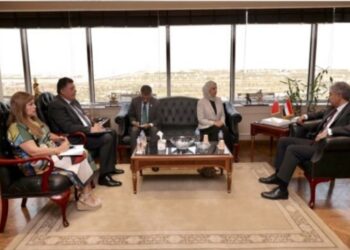
China and Saudi Arabia are set to deepen their bilateral economic and financial cooperation, as affirmed by officials from both countries. This development was highlighted at the third meeting of the Economic and Financial Subcommittee of the High-level Chinese-Saudi Joint Committee, held on Monday in Beijing.
Chinese Finance Minister Lan Fo’an emphasised the robust growth in economic ties between China and Saudi Arabia under the strategic guidance of their leaders. He stressed the importance of macroeconomic policy communication and coordination to bolster global economic recovery and stability. Lan welcomed enhanced exchanges and cooperation between the financial sectors of the two countries, aiming for high-quality, win-win outcomes by aligning Beijing’s modernization goals with Riyadh’s Vision 2030.
Lan stated, “China will take pragmatic and efficient actions to promote high-quality development. We will strengthen macro-policy adjustment, expand domestic demand, and create a first-class business environment that is market-oriented, law-based, and up to international standards.”
Saudi Finance Minister Mohammed Al-Jadaan praised the positive outcomes of economic and trade cooperation between the two nations. He noted the substantial growth in bilateral trade, which reached $107.23 billion in 2023, and highlighted China’s pivotal role in Saudi Arabia’s economic transformation.
“Saudi Arabia is striving to realize Vision 2030, achieving positive results in reforms for economic and social diversification,” said Al-Jadaan. He expressed eagerness to align Saudi strategies with China’s to foster mutual development and prosperity.
The meeting also saw the launch of the first China-Saudi roundtable on finance and business. Liao Min, China’s Vice-Minister of Finance, remarked on the unprecedented potential for economic cooperation, emphasizing collaboration in energy, infrastructure, digital economy, and green development.
The discussions concluded with both sides agreeing to strengthen cooperation in finance, taxation, customs, and investment, and to work closely within the G20 and other international financial institutions, aiming to enhance global economic governance and amplify the voices of emerging markets.