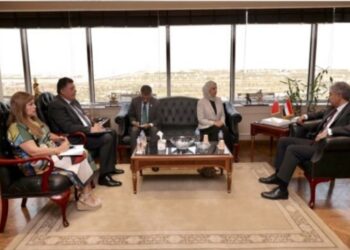
The Iraqi Prime Minister, Mohammed Shia Al-Sudani, has confirmed the possibility of linking China’s Belt and Road Initiative (BRI) with Iraq’s strategic Development Road project. The announcement was made during his meeting on Sunday with Dai Houliang, chairman of China National Petroleum Corporation (CNPC).
A statement from the Prime Minister’s Office highlighted Baghdad’s interest in advancing gas projects, fertiliser industries, energy projects, and constructing a power plant and petrochemical factory.
Launched in 2013, the BRI is a global infrastructure development project involving investments in over 150 countries. According to the World Bank, it has the potential to increase trade flows by 4.1 percent, reduce global trade costs by 1.1 to 2.2 percent, and boost GDP in East Asian and Pacific developing countries by up to 3.9 percent.
Iraq’s $17 billion Development Road project aims to connect the Al-Faw Grand Port in southern Iraq to the Turkish border via an extensive railway and road network. This project is expected to transform Iraq into a transit hub, reducing travel time between Asia and Europe and potentially competing with Egypt’s Suez Canal.
Prime Minister Al-Sudani stated the project includes a railway with an initial capacity of 3.5 million tonnes, which will increase to 7.5 million tonnes in its second phase. Additionally, it will feature a highway, energy pipelines, the Al-Faw Grand Port, and an industrial city, projected to be one of the largest in West Asia.
Several Arab, regional, and European countries have shown interest in investing or participating in the project, recognising its significance as a crucial link between Asia and Europe.
This development underscores China’s growing influence in West Asia, furthered by recent agreements, including a deal to build 1,000 schools in Iraq. The Development Road project promises substantial economic benefits and job opportunities, positioning Iraq as a central player in global trade.