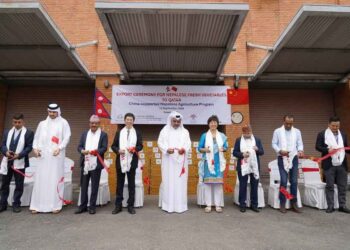
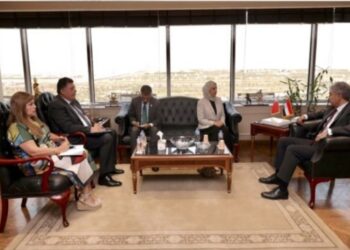
Beijing has played as the host of the 10th-China Arab States Cooperation Forum (CASCF) which has just wrapped up. Presided over directly by Chinese President Xi Jinping, the summit has seen the plurality of the Arab League come together to agree with China on key global issues that concern both sides.
This has cemented China as a viable candidate for a benefactor and overseer of politics in West Asia, something that had already begun on the individual state-to-state level between China and various states in the region.
Uniform agreement on the Palestinian struggle
The summit has culminated in the affirmation of the alignment of the Chinese and the Arab League stances on the Palestine issue in light of the ongoing genocide in Gaza being committed by the US-backed Israeli military.
As of right now, the Arab League and China unanimously agree that a two-state solution based on borders drawn before the 1968 Six-Day War is what they want to see as a solution to the Palestinian struggle to achieve an independent state.
Aside from the armed resistance movement, the immediate hope for the Palestinian liberation struggle is that this results in a joint West and East Asian push upon Israel to stop its expansionist and genocidal efforts in the West Bank and Gaza.
President Xi Jinping has himself iterated his government’s commitment to supporting lasting peace in the region, with a further $69 million being pledged by his country in terms of humanitarian aid for starving and injured civilians in Gaza, along with $3 million in aid for the Gaza-based UN Relief Works Agency.
To that effect, Saudi Foreign Minister Prince Faisal bin Farhan on Thursday praised China’s support for efforts to end the war on Gaza and push for the two-state solution.
Of course, in return for this, the Arab League has also pledged its support for the ‘One China’ principle, effectively recognizing China’s claim that the island of Taiwan is an inalienable part of the People’s Republic of China governed by the Chinese Communist Party and that it should be governed from Beijing.
Countering the IMEC
The India-Middle East Economic Corridor (IMEC), of which Israel is set to be an integral part competes directly with China’s Belt and Road Initiative (BRI). Two of the major participants of the programme are Saudi Arabia and the UAE, and upon the unveiling of the project, Chinese state officials have underscored their desire to not see the IMEC being used as competition to the BRI.
Chinese state media and many social media users have been far more explicit in their negative view of the IMEC however, seeing it as a deliberate move by the US and India to counter Chinese influence at a time when many West Asian governments had expressed their receptiveness to the BRI.
What must also be noted though is that according to the estimations of many, including Iran, the completion of the IMEC project would have ultimately resulted in much of the Arab League working towards normalisation of ties with Israel. The firing shot that at least delayed such plans indefinitely was fired by Hamas with the Al-Aqsa Flood resistance operation on 7 October, 2023.
Under such circumstances, China had no problems re-asserting itself against Israel and pushing the BRI onto West Asia once more, as the end result has been a pushback against US influence and the strengthening of China’s ties with Iran.
As a result of this and the worldwide condemnation of the genocidal actions of Israeli military forces in Gaza, the members of the Arab League, especially Saudi Arabia and the UAE have been pressured into the current affirmations of cooperation with China on friendly terms.
A new Chinese hegemonic paradigm
The summit has been yet another confirmation of the unique Chinese paradigm in Asian regional geopolitics being set by China under the leadership of Xi Jinping. In many ways, it is a confirmation of China’s decision to break away from the wholesale adoption of Western liberal principles.
It is very much in line with the so-called “socialism with Chinese characteristics” championed by the likes of Deng Xiaoping, Jiang Zemin, and Hu Jintao. In its latest iteration under Xi Jinping, China seeks to be recognised as a global hegemon capable of competing directly with the US in all aspects of geopolitics, international trade, and military power.
The symbolism of Arab League heads of state being called to Beijing to attend a summit in which they have made pledges that potentially alter their foreign policies cannot be ignored either.
The completion of the summit and the affirmations within represent a new stage of success in that mission, the mission to materialise a multilateral and multi-polar world order as China competes directly with the US across the world.
It remains to be seen what West Asia’s fate will be under a soft Chinese hegemony and how Israel plans to navigate its relations with China. It must be remembered that Israel and China had previously enjoyed warm relations, even extending to military trade.
It shows that the Chinese Communist Party is not strictly opposed to Israel on ideological faultlines. Depending on the way things go, relations between the two countries may oscillate again.
Embracing West Asia, challenging the West
China’s recent moves are a result of cold calculations for geopolitical gains. But as long as Chinese suzerainty promotes connectivity between West and East Asia and promotes peace in the region, it may objectively still be a better alternative to US suzerainty which has presided over ill-conceived military interventions and civil wars.
Advancement of Chinese interests in Asian geopolitics has in fact done much to bring the previously mutually foreign West and East Asian regions together. Ultimately, however, the overall desire of those in West Asia has been to reduce their reliance on the United States as much as possible.
In contrast to the US, China appears as a much more reliable and workable partner on regional affairs as unlike the former, the latter does not impose upon West Asia its own styles and standards of governance.
However, this is figuratively only the beginning of a much deeper cooperation joined at the hip going ahead. Only time will tell whether the results of the linkage would be a net positive.